Showing posts with label J.L. Austin. Show all posts

Thursday, February 19, 2009

Grice, Austin, Witters, Moore

In Siobhan Chapman's Paul Grice: Philosopher and Linguist, he cites J.L. Austin's quote "Some like Witters, but Moore's my man". (Though it has been circulating around Chicago's philosophy department for a long time as the superior "Everyone's wild about Witters...".) It occurs on p. 51 of Grice's "Reply to Richards", in Grandy and Warner, eds., Philosophical Grounds of Rationality: Intention, Categories, Ends:


Chapman also points out that the title of the book where the passage occurs is an acrostic that reads P GRICE.

Sunday, July 01, 2007

Austin et la question du réalisme

The University of Picardie, Jules Verne hosted a very enjoyable conference on J.L. Austin's Sense and Sensibilia last month in Amiens.


In the background is Amiens cathedral. I took this shot of the town from the top of a 30 foot tall rope jungle gym shaped like the Eiffel Tower:


Amiens has an impressive cathedral. The exterior is covered in carved vignettes. This one is a good symbol for the conference--the saint is at what looks like a podium and the guy listening to him looks like he wants to raise an objection:


Some scenes from the conference. J. Benoist, B. Ambroise, and J. Elliott.


O. Massin, C. Asaleh, C. Ramond, C. Travis, S. Laugier, and a nice woman whose name I don't recall.

Wednesday, June 20, 2007

Oxford Philosophy


Oxford philosophy, fueled by a full English breakfast. Brown's cafe, the covered market, Oxford.

Wednesday, September 13, 2006

Oberkommando des Heeres

Another interesting detail about Austin's notes for How to Do Things With Words I noticed:

The cover page for his Harvard lectures in 1952-1953 (lectures VII, VIII, IX, X (1952) lectures VIII, IX, X, XI (1953)) (p.101 in the volume) is a heavy stock piece of purple paper that Austin must have picked up during his time in the intelligence services in World War II.

The cover looks like this:

Oberkommando des Heeres
Heeres-Personalamt
HARVARD IX
Personalakten
für
------------------------------------
Uttering and Acting
------------------------------------------------------

'Oberkommando des Heeres' translates as 'Army Supreme Command', and 'Personalamt' is something like 'Personnel Office', while 'Personalakten' are 'Personal Files'. Austin has written in his own information in the spaces provided on the cover sheet. This strikes me as hilarious.

Words and Deeds

I've been spending all of my time reading Austin's 'Sense and Sensibilia' lecture notes. Since today is probably my last day in the library, I browsed through the two volumes of his notes for 'How to Do Things With Words'. The most remarkable thing about these notes is that from pp.152-222 (70 pages), on A3 (legal size) sheets of pink paper (some covered front and back), Austin has written densely packed lists of hundreds (probably thousands) of verbs. On a randomly chosen page of 'behabitives', I counted 65 in one column on a four column page! There must be extensive repetition, however, because the verbs are first listed under 'Behabitives', 'Verdictives', 'Exercitives', 'Commissives', etc. , then they are grouped together in a general list that distinguishes between 'explicit', 'implicit', 'descriptive', 'suiting action', and 'non-perfomatives'. It is remarkable.

(If I were allowed to take a picture of these pages, I would, but I'm not, so I won't.)

The first listed verb in the massive list is the verdictive 'absolve' (p. 153) and the last is in a list of 'rights, claims, votes, consents': 'yield'.

Tuesday, September 12, 2006

Reading J.L. Austin

I'm holed up in the John Johnson manuscripts reading room in the Bodleian, reading and transcribing J.L. Austin's notes for his 'Sense and Sensibilia' lecture series. It is slow going--I've gotten through about 50 pages of notes, which represents two lecture series. There are about another 70 pages of lecture notes and maybe 100 pages of miscellaneous scraps that have all been collected.

Austin's handwriting is about 95% intelligible. What takes the most effort is desciphering his shorthand. For example, both 'word' and 'would' get abbreviated as 'wd', 'sixpence' is abbreviated '6d'.

Some other interesting finds:

In his 1947 notes, Austin calls Ayer's search for a 'word that exactly fits the facts' a search for a 'shadow''. (Travis might be interested in this.)

Austin says that the assumption that an object 'ought always to look [the way] we say it is' is 'idiotic'.

In the 1948 lectures he says that if someone says that there is a different sense of 'exist' in the sentence 'The silvery speck does exist and is the star', then there will be a 'million senses! even chimeras!!'

Finally, a note in the 1947 lectures says: 'talk abt Ayer (& Price) in detail: only way seriously to cure insanity.'

Friday, December 16, 2005

How to Do Things With Cover Art, Part II

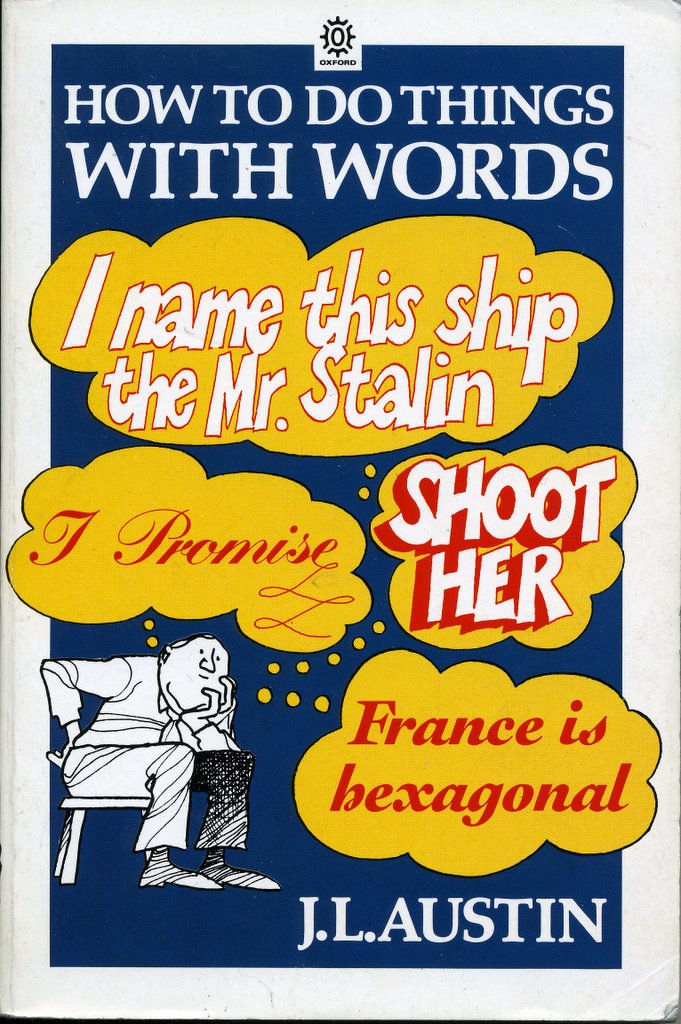
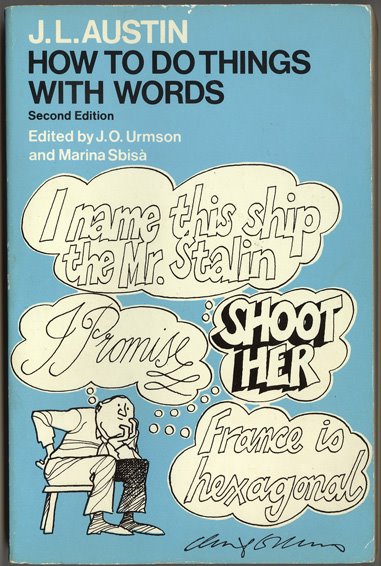
A more recent version of the HTDTWW cover. I think the older version (shown below) is superior.
Monday, December 12, 2005

How to Do Things With Cover Art

(Thanks to Wyeth for the scan of the cover.)

The 1976 Oxford University Press edition of How to Do Things. It has a kind of Schoolhouse Rock quality.

It is far better than the boring Harvard University Press edition that everyone has.

Sunday, December 11, 2005

Companion to J.L. Austin, Part IV: Truth

J.L. Austin, "Truth”

p.117: ‘What is truth?’ said jesting Pilate, and would not stay for an answer: When Pilate questioned Jesus before his crucifixion, Jesus proclaimed that "Everyone on the side of truth listens to me." (John 18:37). To this, Pilate replied "What is truth?" and left Jesus to address those who wanted him crucified (v. 38). Austin’s quote comes from Francis Bacon’s essay "On Truth": "'What is truth?' said jesting Pilate; and would not stay for an answer." (I cribbed this from here.)

p. 118: A pied de la lettre: Literally (‘the foot of the letter’)

p. 126: Air-mosaic: ?? Since Austin worked in Allied intelligence during the war, I assume that this refers to something like a patchwork arrangement of reconnaissance photographs of an area.

p. 126n1: There will not be books in the running brooks until the dawn of hydro-semantics: Shakespeare, As You Like It, Act II. Scene I:


The Forest of Arden. 

Enter DUKE Senior, AMIENS, and other Lords, like Foresters.
Duke S: Now, my co-mates and brothers in exile, 
Hath not old custom made this life more sweet 
Than that of painted pomp? Are not these woods 
More free from peril than the envious court? 
Here feel we but the penalty of Adam, 
The seasons' difference; as, the icy fang 
And churlish chiding of the winter's wind, 
Which, when it bites and blows upon my body, 
Even till I shrink with cold, I smile and say 
'This is no flattery: these are counsellors 
That feelingly persuade me what I am.' 
Sweet are the uses of adversity, 
Which like the toad, ugly and venomous, 
Wears yet a precious jewel in his head; 
And this our life exempt from public haunt, 
Finds tongues in trees, books in the running brooks, 
Sermons in stones, and good in every thing. 
I would not change it.

p.128n1: onomatolatry: idolatry, worship of words

p.130: get a gamma: a gamma is a low mark on the British grading scale (alpha, beta gamma), the equivalent of a C or D.

p. 130: The Primavera: Greek spring festival of renewal.

Links to other posts on Austin: How to Do Things With Words, Chapters 1-6, "Performative Utterances", and "Other Minds".

Tuesday, December 06, 2005

Companion to J.L. Austin, Part III: How To Do Things With Words


J.L. Austin’s How To Do Things With Words

Chapters 1-6


p. 4: parti pris, French, meaning “side taken”; biased

p.8: totalisator, horse racing, bet taking machine

p. 16: purser, a person on a ship responsible for all papers and accounts

p. 17: “Because, despite the name, you do not when bigamous marry twice. (In short the algebra of marriage is BOOLEAN.)” MK’s tentative suggestion, via email: “Boole used exclusive, rather than inclusive, disjunction as his primitive logical addition. Maybe the idea is: a bigamist is either married to wife A or to wife B, but not both.”

p. 25: to crack the crib of reality, Victorian slang for breaking into a house (see also p. 241, “Performative Utterances”)

p. 34: ultra vires, beyond, in excess of one’s legal powers

p. 36: consensus ad idem, "Contract law is based on several Latin legal principles, the most important of which is consensus ad idem, which means a meeting of the minds between the parties or, in other words, a clear understanding, offering and acceptance of each person's contribution. Lawyers say that it is from the moment of "consensus ad idem" that a contract is formed and may be enforced by the courts" (from http://www.duhaime.org/contract/default.aspx)

p. 69: pro tanto, to that extent

p. 81: "‘Snap’. To say this is to snap (in appropriate circumstances); but it is not a snap if ‘snap’ is not said”. “Snap” is a card game: "The whole deck of cards is dealt out to the players who pick up their cards and hold them face down in their hands. Looking at the faces of the cards is not allowed.Starting with the dealer, each player deals one card face up in the centre of the table, making a pile of cards.This is continued until one player deals one card on top of another player's card, which is of the same color and value, e.g. two black sevens. When this happens the first player to call out 'Snap' wins” (from http://www.4to40.com/games/4fun/index.asp?article=games_4fun_snap).

p. 82: J’adoube, “I adjust”, called out when adjusting a piece in chess: "the phrase is used when the player on the move wants to touch a piece without being required to move it by the 'touch move' rule. It must be spoken before the player touches the piece to be adjusted. The player who is not on the move is not required to say anything before touching a piece. It is, however, considered bad form if you touch a piece when it is not your turn to move" (from http://chess.about.com/cs/reference/g/bldefjad.htm).


Links to other posts on Austin: "Truth", "Performative Utterances", and "Other Minds".

Companion to J.L. Austin, Part II: "Performative Utterances"

p. 245: poltroon, coward: “…lily-livered poltroons lacking even the meager courage of a rabbit” (P.G. Wodehouse)

p. 249: mouldy, depressed (British use)

(Philosophical Papers, 3rd edition)

Links to other posts on Austin: "Truth", How to Do Things With Words, Chapters 1-6, and "Other Minds".

Friday, December 02, 2005

A Companion to J.L. Austin, Part I, "Other Minds"

This quarter, I was T.A. for Ted Cohen's class on J.L. Austin. I found that Austin used quite a few words and phrases I was unfamiliar with, and I assumed others would also find them puzzling. So I looked everything up. Here is what I found in "Other Minds".

“Other Minds”

p. 81: IG Farben, German chemical company that made poison gas during WWII.

p. 89: “The awkwardness of some snarks being boojums”, from Lewis Carroll’s poem, “The Hunting of the Snark”:

"Come, listen, my men, while I tell you again/The five unmistakable marks
/By which you may know, wheresoever you go,
/The warranted genuine Snarks.

"Let us take them in order. The first is the taste,
/Which is meager and hollow, but crisp:
/Like a coat that is rather too tight in the waist,
/With a flavor of Will-o-the-wisp.

"Its habit of getting up late you’ll agree/
That it carries too far, when I say
/That it frequently breakfasts at five-o’clock tea,
/And dines on the following day.

"The third is its slowness in taking a jest.
/Should you happen to venture on one,
/It will sigh like a thing that is deeply distressed:
/And it always looks grave at a pun.

"The fourth is its fondness for bathing-machines,/Which it constantly carries about,/
And believes that they add to the beauty of scenes-
/A sentiment open to doubt.

"The fifth is ambition. It next will be right
/To describe each particular batch:
/Distinguishing those that have feathers, and bite,
/And those that have whiskers, and scratch.

"For, although common Snarks do no manner of harm,
/Yet, I feel it my duty to say,
/Some are Boojums-" The Bellman broke off in alarm,
/For the Baker had fainted away.”

p. 93: chivvy, to chase, worry

p. 94: allotropic, the existence of two or more forms of a chemical element

p.98: D.V., Diis Volentibus (Latin: If the Gods Want, epigraph) (not sure about this one, it’s only a guess)

p. 101: gravamen, the essence or most serious part of a complaint or accusation

p.104: Wykehamist, graduate or student of Winchester college

p.106: sequelae (pl. of sequela), condition that is the result of a previous disease or injury

p. 113: ex vi termini, By force of the term (in this context: simply in virtue of what the words mean)

Links to other posts on Austin: How to Do Things With Words, Chapters 1-6, "Performative Utterances", and "Truth".

Sunday, November 13, 2005

Listening to J.L. Austin's 1959 Gothenburg Lecture, "Performatives"


Last Monday I took the tube from Pimlico to Euston to have a listen to J.L. Austin's lecture "Performative Utterances", given at Gothenburg in Sweden in 1959. The British Library owns a tape of the lecture. I was hoping to get a copy so that I could return from my trip with a tape to play for Ted Cohen's class on Austin. That didn't work out, but I am now working on part II of the project to acquire a copy of the lecture, which involves finding out who the copyright holder is. (If anyone has any idea who I should contact with regard to the copyright, please let me know.) Apparently the tape was loaned by Bjorn Haglund of the University of Gothenburg.


In order to listen to the tape, I had to make an appointment with the British Library sound archive and apply for a reader's card, deposit my bag in a locker, put all of my personal belongings in a transparent plastic bag and make my way into the rare music reading room. I was set up in a small glass cubicle and told that the lecture would be piped in from a control room somewhere in the "back". I was told that the tape was two hours long. I took off my jacket, kicked my feet up on the desk and settled in for the afternoon.

The tape began with a sound engineer stating the information the library had about the tape. He said that its provenance was "unknown" (other than the information I gave above). The recording begins with with a lot of shuffling around as the person making the recording tries to get the mic close enough to Austin. Soon, though, Austin's precise, nasal voice comes through loud and clear, and he says how he's going to talk about Performative Utterances. He apologizes for the fact that he is going to set up a distinction (the distinction between performatives and constantives) that he's then going to reject, then he starts his talk. The ensuing talk is an updated version of "Performative Utterances", with additional material from How To Do Things With Words. (Austin at one point acknowledges the point Urmson makes on p.5, note 2 of HTDTWW, about the fact that the British do not actually say "I do" in the marriage ceremony, but says that he's been saying it long enough that he's not going to change it now).

I enjoyed listening to the normal background noises of any typical lecture: scraping chairs, coughing, loud cars driving by outside, people coming in and leaving the lecture hall, etc. After Austin's monologue wound down, I was excited to find out that the lecture would be followed by Q&A.

The discussion that followed the lecture was pretty lopsided, since Austin was in dialogue with a room full of non-native English speakers. None of the questions really provoked him to consider anything new, but it did give him a chance to deploy some new examples. Some of his examples caused me to laugh out loud in my sound-proof booth:

-In the context of a discussion of "France is hexagonal", a Swede asked Austin whether it would be best to say that "hexagonal" has a meaning that is ambiguous, meaning "having six straight sides" in some contexts and something else in other contexts. Austin responded to this question by asking, [this is just paraphrasing, from my notes] "Should we say that in some contexts the meaning of 'hexagonal' means 'having six wiggly sides' or 'having six wobbly sides'?"

-Austin offered as another example of a "rough" statement, "Her behavior at the party was kittenish". He then had to explain to the Swedes what "kittenish" meant. Then followed a discussion of what standards a statement like "Her behavior at the party was kittenish" needed to live up to.

Most interestingly, Austin said that instead of looking for a multiplicity of meanings that a sentence might have, we should try to find a multiplicity of different relations that a statement can have to the facts.

There was also an exchange about whether vagueness and roughness were the same thing. Austin claimed they were distinct, and that they shouldn't be run together.

I left the booth wishing the audience had pressed on certain questions more forcefully, but feeling closer to Austin for having heard his voice.