Tuesday, September 27, 2005

My Recreation of a Caspar David Friedrich


The painting of which this photo is an unconscious imitation is perhaps the most common cover illustration for books of philosophy. Coming in second is probably that Vermeer with the woman holding the scales.

Monday, September 26, 2005

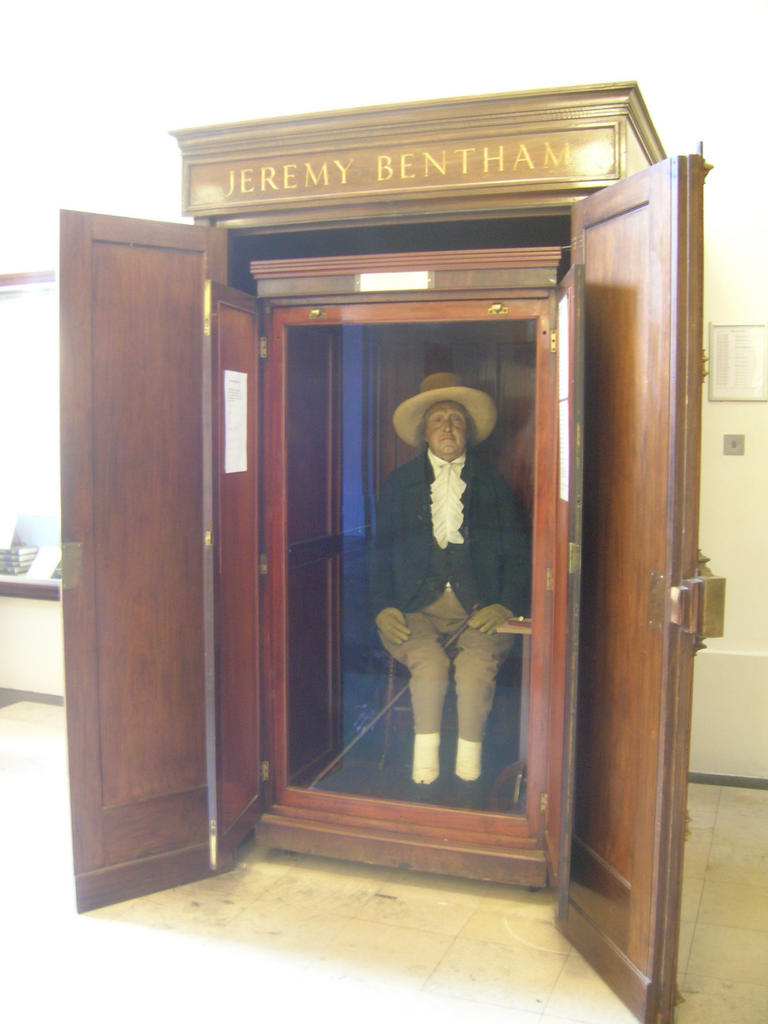
Bentham's Mummified Head


While visiting Bentham's Auto-Icon at University College, London, I learned that it is a MYTH that King's College students kidnapped the head and played a game of soccer with it.

It turns out that they only kidnapped the head and demanded that a ransom of 10 pounds be donated to charity.

The head is now kept in the college safe.

What else do they have in there?

Thursday, September 01, 2005

The Problem of Cognitive Dynamics

On an episode of the Simpsons, Homer says the following to Marge:

"First you didn't want me to get the pony. Now you want me to take it back. Make up your mind!"

Homer does not grasp the way the expression of Marge's want has to change to accommodate changing circumstances. That's why it's funny.

Tuesday, August 23, 2005

One-Upmanship and Folk Psychology

From Stephen Potter, One-Upmanship, p. 22:

"After this opening treatment, Doctor may, under certain circumstances, ask Patient his symptoms. But he will let it be seen that he is not listening to what Patient is saying, and may place his hand on Patient's wrist, or better, stomach, as if to suggest that he as Doctor can tell more through the sensitive tip of one finger than from listening to the layman's self-deceiving, ill-observed, and hysterically redundant impressions of what is wrong with him".

Millikan, Images of Identity: In Search of Modes of Presentation

Strawson's "dot" model of co-referential thinking is anti-Fregean because:

(1) Thinking of an object as the same involves eliminating multiple modes of presentation
(2) A single dot can equivocate in its reference (so sense doesn't determine reference)

Millikan endorses the dot model and argues that Evans's dynamic thoughts are equivalent to the dot model.

Worries about the argument: there are functionally significant reasons for hanging on to multiple modes of presentation for an object, rather than eliminating them when you learn they co-refer. You might, e.g., want to hang on to a variety of modes of presentation for an object because other people refer to the object by way of those modes and don't realize they co-refer.