Friday, December 09, 2005

Mr. T and the Miniature Tractatus


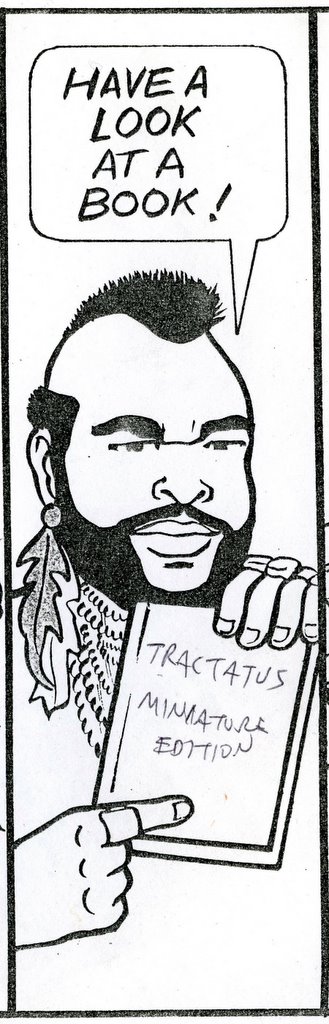
Mr. T is holding a copy of the Tractatus, miniature edition (modified Mr. T bookmark by Wyeth).

A few years ago (maybe 4 or 5 years ago), Zed began to seriously abuse his free CTY copying by reducing works of philosophy to tiny sizes. I still have a miniature copy of McDowell's review of Bernard Williams's Ethics and the Limits of Philosophy. Zed made a whole miniature Tractatus. I believe that when he was writing his preliminary essay, he went to Tanzania with a "library" of his miniature editions.

I think I remember him being inspired to do this by getting a little copy of the US Constitution with a list of all the proposed amendments in the back. Some of the amendments that were proposed but not ratified included a proposal to rename the U.S. the "United States of the World". Another amendment proposed that in order for the U.S. to go to war, there had to be a popular vote. Anyone voting for war would be immediately drafted.

Thursday, December 08, 2005

Wednesday, December 07, 2005

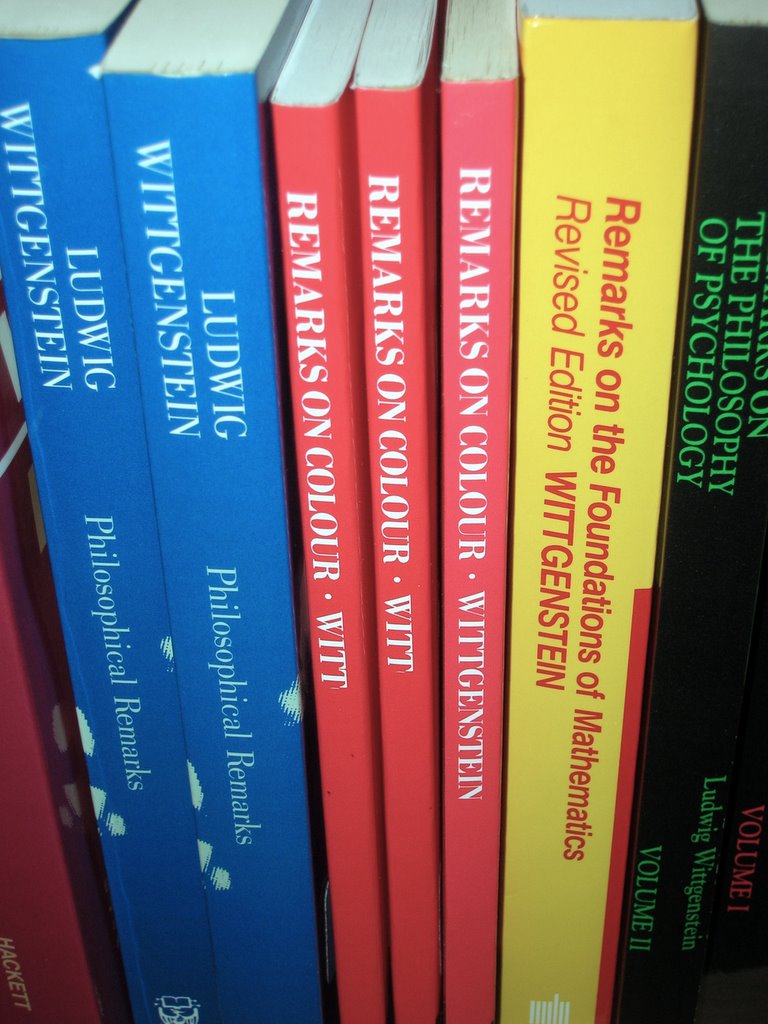
Everyone's Wild About Witters

Seminary Co-op.

Notice the misprinted Remarks on Color. I should pick up a copy as a Wittgenstein curio, like the rare "Ma Black" copy of the Companion to Wittgenstein's Tractatus.

Tuesday, December 06, 2005

Companion to J.L. Austin, Part III: How To Do Things With Words


J.L. Austin’s How To Do Things With Words

Chapters 1-6


p. 4: parti pris, French, meaning “side taken”; biased

p.8: totalisator, horse racing, bet taking machine

p. 16: purser, a person on a ship responsible for all papers and accounts

p. 17: “Because, despite the name, you do not when bigamous marry twice. (In short the algebra of marriage is BOOLEAN.)” MK’s tentative suggestion, via email: “Boole used exclusive, rather than inclusive, disjunction as his primitive logical addition. Maybe the idea is: a bigamist is either married to wife A or to wife B, but not both.”

p. 25: to crack the crib of reality, Victorian slang for breaking into a house (see also p. 241, “Performative Utterances”)

p. 34: ultra vires, beyond, in excess of one’s legal powers

p. 36: consensus ad idem, "Contract law is based on several Latin legal principles, the most important of which is consensus ad idem, which means a meeting of the minds between the parties or, in other words, a clear understanding, offering and acceptance of each person's contribution. Lawyers say that it is from the moment of "consensus ad idem" that a contract is formed and may be enforced by the courts" (from http://www.duhaime.org/contract/default.aspx)

p. 69: pro tanto, to that extent

p. 81: "‘Snap’. To say this is to snap (in appropriate circumstances); but it is not a snap if ‘snap’ is not said”. “Snap” is a card game: "The whole deck of cards is dealt out to the players who pick up their cards and hold them face down in their hands. Looking at the faces of the cards is not allowed.Starting with the dealer, each player deals one card face up in the centre of the table, making a pile of cards.This is continued until one player deals one card on top of another player's card, which is of the same color and value, e.g. two black sevens. When this happens the first player to call out 'Snap' wins” (from http://www.4to40.com/games/4fun/index.asp?article=games_4fun_snap).

p. 82: J’adoube, “I adjust”, called out when adjusting a piece in chess: "the phrase is used when the player on the move wants to touch a piece without being required to move it by the 'touch move' rule. It must be spoken before the player touches the piece to be adjusted. The player who is not on the move is not required to say anything before touching a piece. It is, however, considered bad form if you touch a piece when it is not your turn to move" (from http://chess.about.com/cs/reference/g/bldefjad.htm).


Links to other posts on Austin: "Truth", "Performative Utterances", and "Other Minds".

Companion to J.L. Austin, Part II: "Performative Utterances"

p. 245: poltroon, coward: “…lily-livered poltroons lacking even the meager courage of a rabbit” (P.G. Wodehouse)

p. 249: mouldy, depressed (British use)

(Philosophical Papers, 3rd edition)

Links to other posts on Austin: "Truth", How to Do Things With Words, Chapters 1-6, and "Other Minds".

Saturday, December 03, 2005

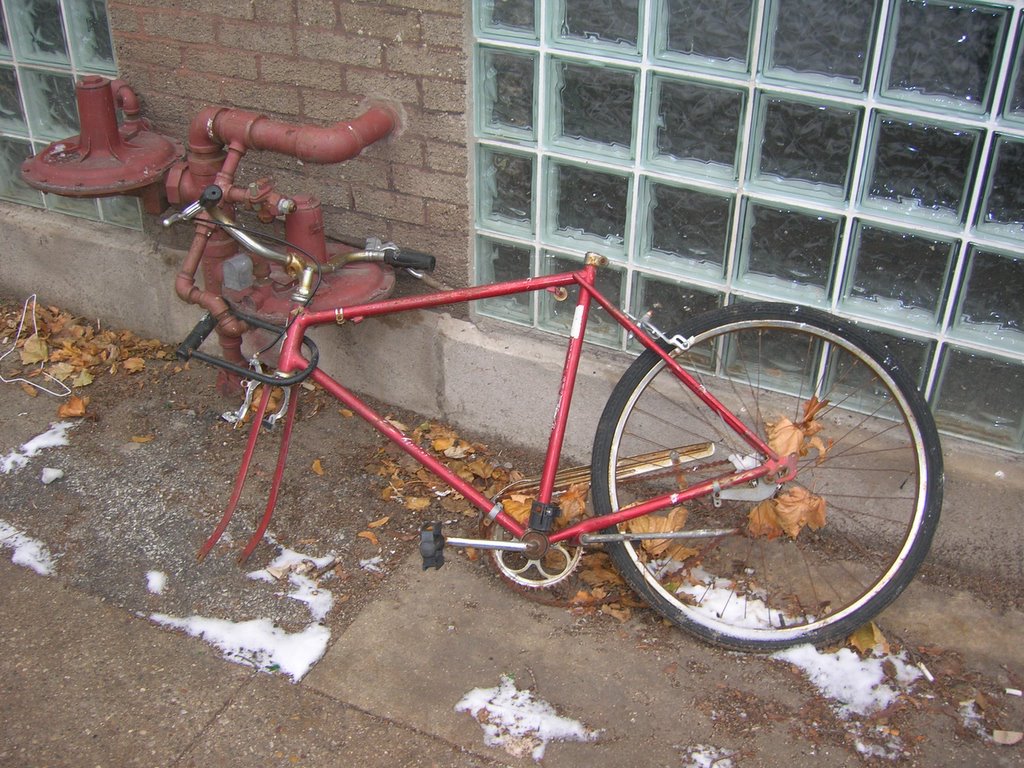
Decrepit Bikes

Hyde Park, 54th Street

Hyde Park, 53rd Street

Oxford, Radcliffe Square, 2002.

Friday, December 02, 2005

A Companion to J.L. Austin, Part I, "Other Minds"

This quarter, I was T.A. for Ted Cohen's class on J.L. Austin. I found that Austin used quite a few words and phrases I was unfamiliar with, and I assumed others would also find them puzzling. So I looked everything up. Here is what I found in "Other Minds".

“Other Minds”

p. 81: IG Farben, German chemical company that made poison gas during WWII.

p. 89: “The awkwardness of some snarks being boojums”, from Lewis Carroll’s poem, “The Hunting of the Snark”:

"Come, listen, my men, while I tell you again/The five unmistakable marks
/By which you may know, wheresoever you go,
/The warranted genuine Snarks.

"Let us take them in order. The first is the taste,
/Which is meager and hollow, but crisp:
/Like a coat that is rather too tight in the waist,
/With a flavor of Will-o-the-wisp.

"Its habit of getting up late you’ll agree/
That it carries too far, when I say
/That it frequently breakfasts at five-o’clock tea,
/And dines on the following day.

"The third is its slowness in taking a jest.
/Should you happen to venture on one,
/It will sigh like a thing that is deeply distressed:
/And it always looks grave at a pun.

"The fourth is its fondness for bathing-machines,/Which it constantly carries about,/
And believes that they add to the beauty of scenes-
/A sentiment open to doubt.

"The fifth is ambition. It next will be right
/To describe each particular batch:
/Distinguishing those that have feathers, and bite,
/And those that have whiskers, and scratch.

"For, although common Snarks do no manner of harm,
/Yet, I feel it my duty to say,
/Some are Boojums-" The Bellman broke off in alarm,
/For the Baker had fainted away.”

p. 93: chivvy, to chase, worry

p. 94: allotropic, the existence of two or more forms of a chemical element

p.98: D.V., Diis Volentibus (Latin: If the Gods Want, epigraph) (not sure about this one, it’s only a guess)

p. 101: gravamen, the essence or most serious part of a complaint or accusation

p.104: Wykehamist, graduate or student of Winchester college

p.106: sequelae (pl. of sequela), condition that is the result of a previous disease or injury

p. 113: ex vi termini, By force of the term (in this context: simply in virtue of what the words mean)

Links to other posts on Austin: How to Do Things With Words, Chapters 1-6, "Performative Utterances", and "Truth".