Wednesday, November 09, 2005

Oxford Conference in Review (Part II: Other People's Papers)


I sat in on three student papers and Ted Sider's keynote speech. I think I learned quite a bit from these talks.

I'll take them in order. (If I misrepresent what was said by anyone, which is probable, feel free to let me know and I'll try to fix it).

1. Mr. Wayne Wu (WW), "...Conceptual Content..."

Very roughly: WW argued that perceptual content was conceptual because certain psychological experiments suggest that semantic memory (which is conceptual) is involved in perceptually-guided tasks (like picking things up).

The Q&A session was enjoyable and packed with good, substantial questions. I was most interested in WW's criticism of "demonstrative" theories of intention, which he thought were unable to account for the amount and quality of information we receive when we perceive and successfully interact with objects. I had a question that I didn't get to ask because I didn't raise my hand soon enough, but it concerned whether WW was fair to demonstrative accounts (of perception or intention) when he characterized them as (1) committed to the idea that you can have a demonstrative thought about an object (or direct a demonstrative intention towards an object) so long as you can spatially locate the object, and (2) that you can locate an object (in this case, a hammer), by reaching out and touching a certain distinctive part of it (the handle, say). WW said that because the demonstrative theorist is committed to saying that such a person could have demonstrative thoughts about the hammer, but may not be able to successfully pick it up (not knowing what part of the handle he's touching, or where the head is, or whether it is obstructed by something), the demonstrative theorist didn't have an adequate account of how perception contributes to successful action. But when WW went on to contrast his own account of how perception contributes to successful action, he imagined a situation in which a subject could see the whole object that he intended to act on. But if one could only see a bit of the hammer (if it was protruding from under a couch, say), then one might very well have the same problem successfully picking it up. So I didn't think he really dispatched the demonstrative theorist, though I'm unsure of how important this is for the overall argument of his paper, which was enjoyable and provocative in many other respects.

2. Mr. Matthew Haug (MH), "Is Multiple Realizability Necessary for Irreducibility?"

MH gave a clear and well-reasoned argument that the answer to the question in his title is no. It is usually assumed that the multiple realizability of mental states in physical states is required for irreducibility. But MH wanted to suggest that another relation, the determinate-determinable property relation, gave us a way of seeing how mental properties are irreducible to their physical realizers. He said that the structure that realizes the mental property will be "multiply determinative", realizing many different mental properties, and so no 1-1 reduction of mental propeties to physical properties was possible. MH's paper was very clear and well presented. WW asked a question of MH's paper that I also was wondering about, namely, whether someone could respond to his paper by saying that the determinate mental properties are not all realized in the same physical "structure" (there was also some debate about the meaning and significance of "structure" in the paper), but by different, corresponding physical properties of the structure. Take, e.g., MH's example, "the structure of a cubical peg simultaneously realizes the peg's shape, color, mass, and rigidity". Mightn't one say that different elements of the structure realize the color, mass and rigidity of the peg?

3. Prof. Ted Sider, (TS), "Ontological Realism"

TS rocked the mic in front of a large gathering of philosophers in Exeter College's Saskatchewan room. He gave a fantastically clear and absorbing account of debates about the composition of objects. There was a great deal of interesting material in his paper, but what I found most interesting was a fertile methodlogical question he raised: what makes a dispute "merely verbal"? TS wanted to argue that debates about the composition of objects are not merely verbal, despite a common feeling that they are. I think it would be a productive project to look at other examples of someone claiming that something is a "merely verbal" dispute. The only example that immediately came to mind was Francois Recanti's charge in Direct Reference that the dispute between Evans/McDowell and various narrow content theorists over the role of mental content in action-explanation is merely verbal. (When I ran into Josef Stern this morning walking across the quad, he said that Hume says debates about god are merely verbal. If anyone knows of any other examples of philosophers (or members of the folk) saying that a debate is merely verbal or merely terminological, let me know.)

4. Mr. Daniel Whiting (DW), "Meaning Theories and the Principle of Humanity"

DW raised a concern about the modest meaning theories of McDowell and Wiggins. Here is my thumbnail version of the concern: if one aims merely to give a perspicuous overview of the way meaning, truth, force and psychological explanation interact, then why pursue that project by advocating a Davidsonian truth-theory for a language? Why begin the elucidatory project without helping oneself to the concept of meaning? I asked DW if he would agree with my feeling that if the goal of the modest theorists is to explore the way these important concepts are interdependent, then a project like J.L. Austin's might be more appropriate than a t-theory. He said that he thought that thinking about Austin's relevance to these kinds of questions was interesting.


Tuesday, November 08, 2005

Oxford Conference in Review (Part I: My Paper)


The Oxford Graduate Conference this weekend was the best run and most fun conference I've been to. The number of faculty who turned out to multiple student presentations was impressive. I received very helpful and friendly feedback from my commentator, Stephen Williams, and from the grad student and faculty audience members. As well as I can remember, the questions were as follows:

David Alexander asked a follow-up to Stephen Williams' comment regarding the way the "name-perpetuation" and "chain" accounts of internal continuity over-intellectualize the way we keep track of objects over time and space. That gave me a chance to explain that I am most interested in the idea (in Campbell's "Is Sense Transparent?" and in parts of Evans' Varieties of Reference) that there are background presuppositions in place that cut down the number of senses required in a given situation. The next step for this project is to work out exactly what that kind of approach would require. I explained how I thought one thing that it appears to sacrifice is a unified space of reasons, which the (unmodified) Intuitive Criterion of Difference (ICD) makes possible. The point of this paper is to see what you have to do to think about objects if you accept the criterion as stated by Evans. But I'm more than happy to think about ways to modify it.

Timothy Williamson asked about the synchronic status of the ICD and whether I was ignoring that in generating worries about whether we can think the same thought through time. I admitted there was something fishy about the way I generate the worry about thoughts had at different times by claiming that a subject can wonder, at time t1, whether THAT F [currently seen] = THAT F [remembered from a moment ago]. The bracketed bits are supposed to be demonstrations. The left hand side of the identity is a perceptual demonstrative while the right hand side is a memory demonstrative. But what Williamson was querying, I think, was whether showing that the demonstrative, memory-based thought and the demonstrative perceptually-based thought weren't the same thought by application of the ICD thereby shows that there isn't a continuous, present-tense sense that lasts from t1 to t2. I agree that the possibility of doubting that THAT F [currently seen] = THAT F [remembered from a moment ago] doesn't show that there isn't a continuous present-tense sense that lasts from t1 to t2. That's okay, I think, for my purposes in this paper, since what I am concerned with is how our thoughts about an object thought about under different senses at a single time can so much as be valid for the subject (that is, how they can have internal continuity).

Daniel Whiting also asked about presupposition and individuating senses. I said that I thought it was important to be clear that if you make sameness and difference of sense dependent on certain kinds of background presuppositions, you would be making what seemed to me to be a very un-Fregean move. That's not to say that I don't want to make such a move, only that it's important to know what you're getting yourself into (I think you'd be getting yourself into a context-dependent view of sense).

Michael Ayers asked whether a similar problem of internal continuity wouldn't arise in the case of concept-expressions just as with singular terms. Isn't it possible for someone to coherently doubt that, say, "x is sharp" as it appears in different sentences refers to the same property? I said that I thought the answer to his question is "yes", and that we should say similar things about predicates as we did about singular terms. I asked him if he thought there were any special problems posed by concept-expressions, but he didn't say so. But now, on reflection, there might be a serious worry here about the way I try to use anaphora to connect tokens of singular terms together, since there isn't any parallel for anaphora for concept-expressions (I think). So the anaphora aspect of the paper may be a red-herring. This came out in discussion with my moderator after the talk as well.

The chair, Maria Lasonen, asked whether I was entitled to rely on anaphora to explain continuity when it seems that understanding anaphora itself requires understanding the concept of co-reference. (Zed asked a question like this when I gave the paper to the Philosophy of Mind Workshop last year). I said that I wasn't trying to explain the phenomenon of co-reference itself. Invoking anaphora to explain that would be pretty clearly circular. I thought anaphora gave us a kind of co-reference that was achieved simply in understanding a sentence, thereby blocking the kind of doubt the ICD turns on (the ICD requires that it be possible to coherently assent/dissent to two sentences both of which you understand. So the basic trick of the paper is to try to find a kind of co-reference that is guaranteed simply in virtue of understanding the relevant sentences.

I want to post some comments about the other papers I heard, as well as my adventure tracking down an audio recording of a J.L. Austin lecture sometime soon, but right now I'm totally wearied by jet lag.

Tuesday, September 27, 2005

My Recreation of a Caspar David Friedrich


The painting of which this photo is an unconscious imitation is perhaps the most common cover illustration for books of philosophy. Coming in second is probably that Vermeer with the woman holding the scales.

Monday, September 26, 2005

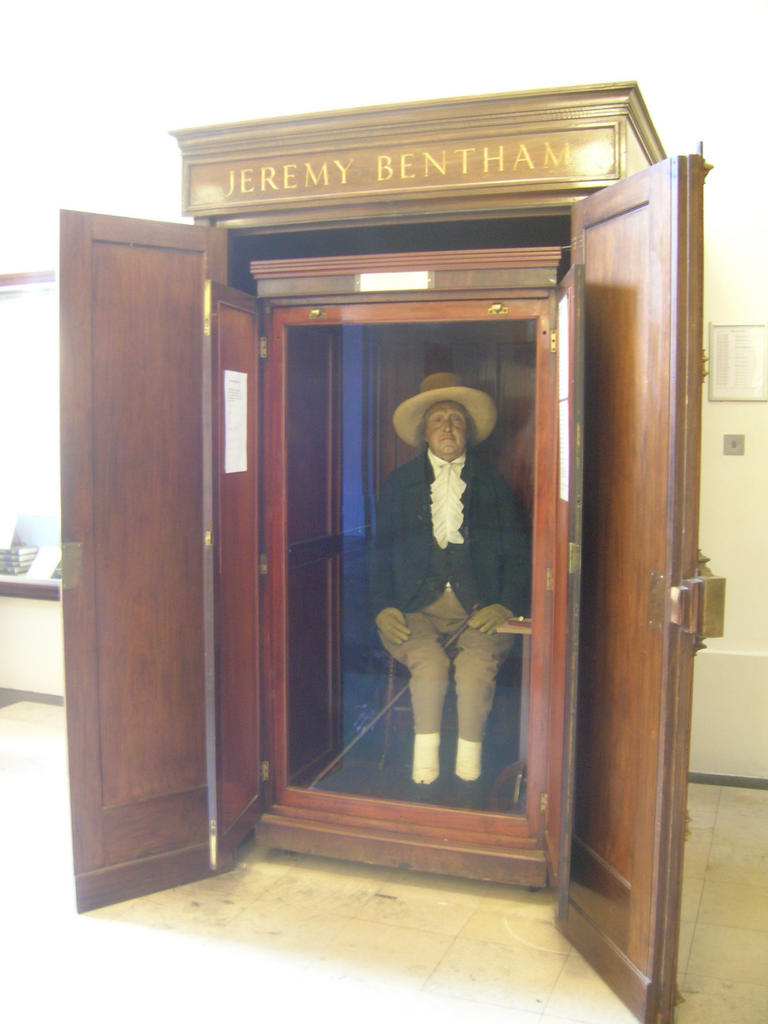
Bentham's Mummified Head


While visiting Bentham's Auto-Icon at University College, London, I learned that it is a MYTH that King's College students kidnapped the head and played a game of soccer with it.

It turns out that they only kidnapped the head and demanded that a ransom of 10 pounds be donated to charity.

The head is now kept in the college safe.

What else do they have in there?

Thursday, September 01, 2005

The Problem of Cognitive Dynamics

On an episode of the Simpsons, Homer says the following to Marge:

"First you didn't want me to get the pony. Now you want me to take it back. Make up your mind!"

Homer does not grasp the way the expression of Marge's want has to change to accommodate changing circumstances. That's why it's funny.